
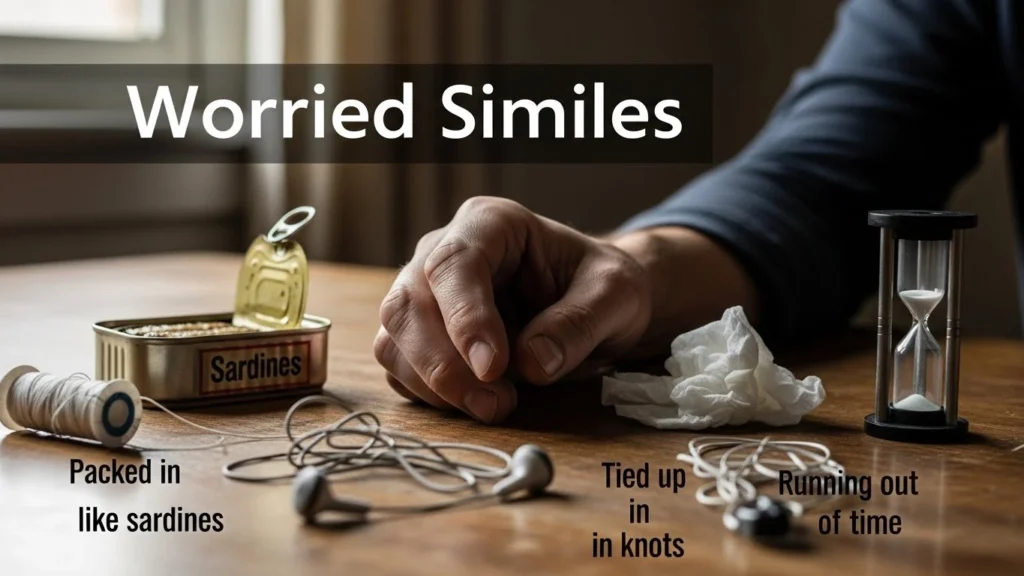
Similes are a powerful part of figurative language. They help us explain feelings by comparing them to something familiar, using words like “as” or “like.” Instead of simply saying “I am worried,” a simile paints a picture that helps readers feel the emotion. That’s why similes are so commonly used in stories, poems, daily conversations, and even text messages.
When it comes to emotions, worry can be especially hard to describe. It can feel heavy, restless, sharp, or quietly overwhelming. Worried similes give writers and speakers a creative way to express anxiety, stress, nervousness, and concern in a vivid and relatable manner. In this guide, you’ll find 25 carefully explained similes, each with meaning, tone, usage context, and multiple examples to help you use them naturally in real life.
1. Worried like a cat in a room full of rocking chairs
Meaning & Definition: This simile describes extreme nervousness and constant alertness, as if danger could strike at any moment.
Tone: Humorous but anxious
Best Usage Context: Storytelling, casual conversation, expressive writing
Examples:
- He was worried like a cat in a room full of rocking chairs before the interview.
- She paced the floor, worried like a cat surrounded by danger.
- I felt worried like a cat in a room full of rocking chairs waiting for the results.
Daily Use: “Stop pacing—you look worried like a cat in a room full of rocking chairs.”
2. Worried like a mouse hiding from a shadow
Meaning & Definition: Shows fear that is exaggerated or driven by imagination.
Tone: Gentle, descriptive
Best Usage Context: Children’s stories, emotional descriptions
Examples:
- He was worried like a mouse hiding from a shadow.
- She flinched at every sound, worried like a mouse.
- The child waited nervously, worried like a tiny mouse.
3. Worried as a student before final exams
Meaning & Definition: Represents common, relatable stress tied to pressure and expectations.
Tone: Relatable and realistic
Best Usage Context: Everyday speech, academic writing
Examples:
- I’m worried as a student before final exams.
- She looked worried as finals week approached.
- He stayed up all night, worried as a student before exams.
Texting Example: “I’m worried as a student before finals 😟”
4. Worried like a storm cloud ready to burst
Meaning & Definition: Suggests worry building up and ready to explode emotionally.
Tone: Dramatic, vivid
Best Usage Context: Creative writing, poetry
Examples:
- His face was dark, worried like a storm cloud.
- She carried her worry like a cloud ready to burst.
- The room felt heavy, worried like an approaching storm.
5. Worried as a parent waiting for a late child
Meaning & Definition: Captures deep emotional concern rooted in love and fear.
Tone: Emotional, serious
Best Usage Context: Narrative writing, emotional scenes
Examples:
- She was worried as a parent waiting past midnight.
- He checked his phone, worried like any parent would be.
- Her heart raced, worried as a mother waiting.
6. Worried like a ticking clock
Meaning & Definition: Shows constant, ongoing worry that never stops.
Tone: Tense, symbolic
Best Usage Context: Inner monologues, reflective writing
Examples:
- His worry ticked away like a clock.
- She felt worried like time counting down.
- The pressure grew, worried like a ticking clock.
7. Worried as a deer caught in headlights
Meaning & Definition: Describes sudden fear and frozen anxiety.
Tone: Visual, intense
Best Usage Context: Action scenes, real-life moments
Examples:
- He froze, worried as a deer in headlights.
- She stood silent, worried and unsure.
- I felt worried like a deer caught off guard.
8. Worried like waves crashing endlessly
Meaning & Definition: Represents recurring, overwhelming worry.
Tone: Poetic, heavy
Best Usage Context: Poetry, emotional writing
Examples:
- Worry hit him like endless waves.
- Her thoughts crashed, worried and loud.
- The anxiety came back, worried like waves.
9. Worried as a balloon stretched too tight
Meaning & Definition: Shows pressure building, close to breaking.
Tone: Symbolic, tense
Best Usage Context: Mental health writing
Examples:
- She felt worried as a balloon ready to pop.
- His nerves stretched too far.
- The tension grew, worried and fragile.
10. Worried like footsteps behind you at night
Meaning & Definition: Describes fear mixed with imagination.
Tone: Suspenseful
Best Usage Context: Storytelling, suspense scenes
Examples:
- He felt worried like footsteps followed him.
- She kept looking back, worried and tense.
- The silence made him worried like footsteps in the dark.
11. Worried as a phone with low battery
Meaning & Definition: Modern simile for constant concern about running out of time or energy.
Tone: Relatable, modern
Best Usage Context: Texting, casual speech
Examples:
- I’m worried as a phone on 1%.
- She smiled, but worried like a dying battery.
- He rushed, worried and drained.
Texting Example: “I’m worried as a phone on 1% 🔋”
12. Worried like paper in the rain
Meaning & Definition: Shows vulnerability and helplessness.
Tone: Soft, emotional
Best Usage Context: Descriptive writing
Examples:
- She felt worried like paper in rain.
- His plans dissolved, worried and weak.
- The moment left him fragile.
13. Worried as a bird trapped indoors
Meaning & Definition: Expresses restless anxiety and desire for escape.
Tone: Symbolic
Best Usage Context: Creative prose
Examples:
- He paced, worried as a trapped bird.
- Her mind fluttered with worry.
- Anxiety beat its wings inside her.
14. Worried like sand slipping through fingers
Meaning & Definition: Shows fear of losing control.
Tone: Reflective
Best Usage Context: Philosophical writing
Examples:
- Time slipped away, worried like sand.
- She tried to hold on, worried and helpless.
- The chance faded, worry growing.
15. Worried as a test result loading slowly
Meaning & Definition: Captures suspense and anticipation.
Tone: Light, relatable
Best Usage Context: Modern writing
Examples:
- I waited, worried as a loading screen.
- She stared at the screen, anxious.
- His heart raced while waiting.
16. Worried like a kettle about to whistle
Meaning & Definition: Represents rising tension.
Tone: Visual
Best Usage Context: Emotional build-up scenes
Examples:
- Pressure built, worried like a kettle.
- She felt close to breaking.
- The silence screamed worry.
17. Worried as a tightrope walker
Meaning & Definition: Shows careful balance and fear of mistakes.
Tone: Serious
Best Usage Context: Life challenges, decisions
Examples:
- He lived worried as a tightrope walker.
- One slip could ruin everything.
- She moved carefully, worried.
18. Worried like thunder before rain
Meaning & Definition: Suggests impending trouble.
Tone: Dramatic
Best Usage Context: Foreshadowing
Examples:
- The air felt worried like thunder.
- Trouble loomed close.
- Anxiety rolled in slowly.
19. Worried as a locked door without a key
Meaning & Definition: Shows helplessness and frustration.
Tone: Symbolic
Best Usage Context: Emotional writing
Examples:
- She felt stuck and worried.
- His options felt locked.
- Anxiety sealed the moment.
20. Worried like glass about to crack
Meaning & Definition: Represents fragile emotional state.
Tone: Intense
Best Usage Context: Mental health themes
Examples:
- He felt worried like cracking glass.
- Pressure made her shake.
- One word could break him.
21. Worried as a secret about to spill
Meaning & Definition: Shows anxious anticipation.
Tone: Suspenseful
Best Usage Context: Drama, secrets
Examples:
- She waited, worried the truth would spill.
- His silence screamed worry.
- The moment stretched painfully.
22. Worried like ice on thin water
Meaning & Definition: Suggests danger and instability.
Tone: Serious
Best Usage Context: Metaphorical writing
Examples:
- He stood worried like thin ice.
- One step felt risky.
- Anxiety cracked beneath him.
23. Worried as a candle in the wind
Meaning & Definition: Shows fragility and uncertainty.
Tone: Poetic
Best Usage Context: Poems, reflective prose
Examples:
- She flickered, worried and unsure.
- His hope shook in the wind.
- The moment felt fragile.
24. Worried like a countdown timer
Meaning & Definition: Represents time-based anxiety.
Tone: Modern
Best Usage Context: Deadlines, pressure moments
Examples:
- He watched the clock, worried like a countdown.
- Time pressed hard.
- Anxiety grew with each second.
25. Worried as silence before bad news
Meaning & Definition: Shows dread and anticipation.
Tone: Heavy, emotional
Best Usage Context: Serious narratives
Examples:
- The room felt worried and silent.
- She braced herself.
- Anxiety filled the pause.
FAQs
1. What are worried similes? Worried similes are comparisons that creatively describe anxiety, fear, or concern using “like” or “as.”
2. Why are similes useful for expressing worry? They make emotions vivid, relatable, and easier to understand.
3. Can worried similes be used in daily conversation? Yes, many are perfect for casual speech, texting, and storytelling.
4. Are worried similes good for creative writing? Absolutely. They add depth, imagery, and emotional impact.
5. How can I create my own worried similes? Think of how worry feels and compare it to something familiar or visual.
Conclusion
Worry is a complex emotion, but worried similes give it shape, color, and meaning. Whether you’re writing a story, sending a text, or trying to express your feelings more clearly, similes help turn abstract emotions into powerful images. By using them thoughtfully, you can make your language more engaging, expressive, and memorable. Let these similes inspire you to write with confidence, creativity, and emotional depth.

Emily Carter is a grammar coach and freelance writer with a deep love for the English language. She writes engaging lessons and tips on punctuation, spelling, and sentence structure to help learners communicate clearly and effectively.