
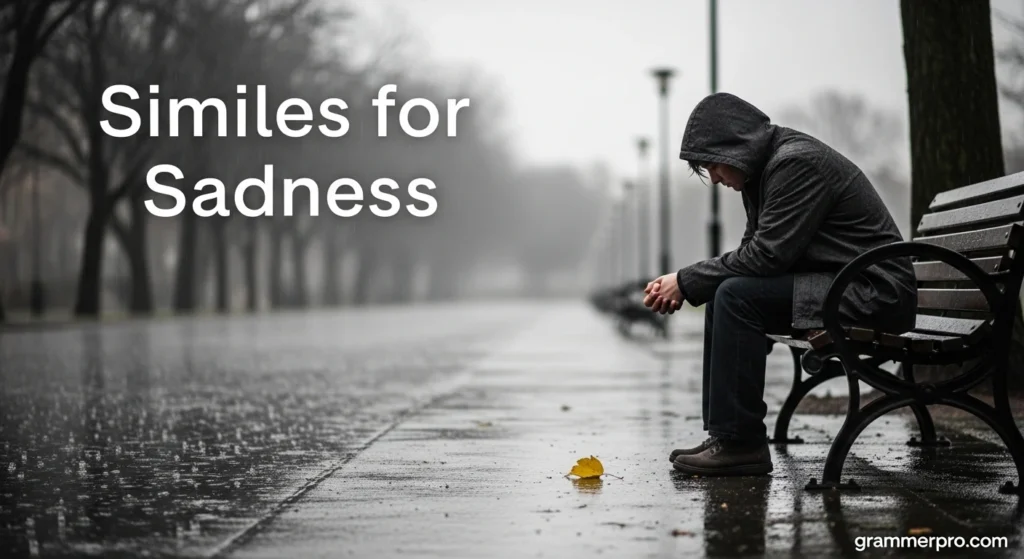
Sadness is one of the most universal human emotions, yet it can be surprisingly difficult to put into words. That’s where similes come in. A simile is a figure of speech that compares two different things using words like “as” or “like”. These comparisons help bring emotions to life, making your writing more vivid, relatable, and emotionally powerful.
When you use similes for sadness, you transform abstract feelings into clear mental images. Instead of simply saying “I feel sad,” you can paint a picture that others instantly understand. Whether you’re writing stories, captions, poetry, or even messages, similes make your expression deeper and more memorable.
Below, you’ll find 25 carefully crafted similes for sadness, each explained in detail with meaning, tone, usage, and natural examples.
As sad as a rainy day
- Meaning: A dull, gloomy, and emotionally heavy feeling
- Tone: Soft, reflective
- Best Use: Everyday sadness or quiet disappointment
Examples:
- She looked as sad as a rainy day after hearing the news.
- The empty streets felt as sad as a rainy day.
- His voice sounded as sad as a rainy day on Monday morning.
As sad as a broken toy
- Meaning: Feeling damaged, abandoned, or unloved
- Tone: Childlike, emotional
- Best Use: Emotional vulnerability
Examples:
- He sat there as sad as a broken toy.
- Her eyes looked as sad as a broken toy left behind.
- I felt as sad as a broken toy after they ignored me.
As sad as a wilted flower
- Meaning: Loss of energy, beauty, or hope
- Tone: Poetic, gentle
- Best Use: Emotional decline
Examples:
- She looked as sad as a wilted flower in the heat.
- His smile faded, as sad as a wilted flower.
- The room felt as sad as a wilted flower.
As sad as a lonely cloud
- Meaning: Feeling isolated or disconnected
- Tone: Dreamy, introspective
- Best Use: Loneliness
Examples:
- He drifted through life as sad as a lonely cloud.
- I felt as sad as a lonely cloud in the sky.
- She stood there, as sad as a lonely cloud.
As sad as an empty room
- Meaning: Emotional emptiness and silence
- Tone: Quiet, haunting
- Best Use: Isolation
Examples:
- The house felt as sad as an empty room.
- Without you, everything feels as sad as an empty room.
- His heart was as sad as an empty room.
As sad as a fading sunset
- Meaning: A beautiful but painful ending
- Tone: Melancholic, poetic
- Best Use: Goodbyes
Examples:
- Their farewell was as sad as a fading sunset.
- I felt as sad as a fading sunset watching her leave.
- The moment felt as sad as a fading sunset.
As sad as a lost puppy
- Meaning: Confused, abandoned, and helpless
- Tone: Emotional, sympathetic
- Best Use: Vulnerability
Examples:
- He looked as sad as a lost puppy.
- She felt as sad as a lost puppy in a crowd.
- His expression was as sad as a lost puppy.
As sad as a forgotten song
- Meaning: Feeling unimportant or overlooked
- Tone: Nostalgic
- Best Use: Neglect
Examples:
- I felt as sad as a forgotten song.
- Her dreams seemed as sad as a forgotten song.
- The memory lingered, as sad as a forgotten song.
As sad as a broken mirror
- Meaning: Emotional fragmentation or self-doubt
- Tone: Deep, reflective
- Best Use: Identity struggles
Examples:
- He felt as sad as a broken mirror.
- Her confidence shattered, as sad as a broken mirror.
- I stared at myself, as sad as a broken mirror.
As sad as a cold winter night
- Meaning: Deep loneliness and emotional coldness
- Tone: Heavy, intense
- Best Use: Isolation
Examples:
- The silence felt as sad as a cold winter night.
- I felt as sad as a cold winter night without you.
- His thoughts were as sad as a cold winter night.
As sad as a sinking ship
- Meaning: Hopelessness and inevitable loss
- Tone: Dramatic
- Best Use: Despair
Examples:
- His dreams felt as sad as a sinking ship.
- She looked as sad as a sinking ship.
- Everything felt as sad as a sinking ship.
As sad as a dying flame
- Meaning: Fading hope or energy
- Tone: Soft, poetic
- Best Use: Emotional exhaustion
Examples:
- His hope flickered, as sad as a dying flame.
- I felt as sad as a dying flame.
- Her voice was as sad as a dying flame.
As sad as a silent tear
- Meaning: Quiet, hidden sadness
- Tone: Subtle, emotional
- Best Use: Internal emotions
Examples:
- She cried, as sad as a silent tear.
- His pain was as sad as a silent tear.
- I felt as sad as a silent tear.
As sad as a deserted street
- Meaning: Emptiness and abandonment
- Tone: Visual, cinematic
- Best Use: Loneliness
Examples:
- The city looked as sad as a deserted street.
- I felt as sad as a deserted street at night.
- His life seemed as sad as a deserted street.
As sad as a broken heart
- Meaning: Emotional pain from love or loss
- Tone: Universal, relatable
- Best Use: Relationships
Examples:
- She felt as sad as a broken heart.
- His expression was as sad as a broken heart.
- I was as sad as a broken heart after the breakup.
As sad as a falling leaf
- Meaning: Gentle loss or change
- Tone: Calm, poetic
- Best Use: Transitions
Examples:
- The moment felt as sad as a falling leaf.
- I felt as sad as a falling leaf in autumn.
- Her goodbye was as sad as a falling leaf.
As sad as a forgotten letter
- Meaning: Neglected emotions or memories
- Tone: Nostalgic
- Best Use: Past regrets
Examples:
- He felt as sad as a forgotten letter.
- The memory lingered as sad as a forgotten letter.
- I was as sad as a forgotten letter.
As sad as a cloudy sky
- Meaning: Persistent gloom
- Tone: Neutral, everyday
- Best Use: General sadness
Examples:
- I felt as sad as a cloudy sky.
- Her mood was as sad as a cloudy sky.
- The day felt as sad as a cloudy sky.
As sad as a cracked bell
- Meaning: Broken expression or muted voice
- Tone: Symbolic
- Best Use: Emotional suppression
Examples:
- His laughter sounded as sad as a cracked bell.
- I felt as sad as a cracked bell.
- Her words rang as sad as a cracked bell.
As sad as a dim candle
- Meaning: Weak emotional energy
- Tone: Gentle
- Best Use: Quiet sadness
Examples:
- Her smile was as sad as a dim candle.
- I felt as sad as a dim candle.
- His hope flickered as sad as a dim candle.
As sad as a broken clock
- Meaning: Feeling stuck or lost in time
- Tone: Reflective
- Best Use: Regret
Examples:
- I felt as sad as a broken clock.
- His life seemed as sad as a broken clock.
- The moment felt as sad as a broken clock.
As sad as a dark tunnel
- Meaning: Hopelessness without visible end
- Tone: Intense
- Best Use: Depression
Examples:
- He felt as sad as a dark tunnel.
- Life seemed as sad as a dark tunnel.
- I felt trapped, as sad as a dark tunnel.
As sad as a lost memory
- Meaning: Emotional emptiness from forgetting
- Tone: Deep, nostalgic
- Best Use: Memory loss
Examples:
- I felt as sad as a lost memory.
- Her thoughts were as sad as a lost memory.
- The feeling lingered as sad as a lost memory.
As sad as a silent song
- Meaning: Beauty without expression
- Tone: Poetic
- Best Use: Creative writing
Examples:
- Her voice felt as sad as a silent song.
- I felt as sad as a silent song.
- The moment was as sad as a silent song.
As sad as a fading echo
- Meaning: Disappearing presence or memory
- Tone: Haunting
- Best Use: Loss
Examples:
- His memory faded as sad as an echo.
- I felt as sad as a fading echo.
- The sound lingered, as sad as a fading echo.
Quick Daily-Use & Texting Examples
- “I feel as sad as a rainy day today.”
- “Missing you… feels like a fading sunset.”
- “Honestly, I’m like a lost puppy right now.”
- “Today feels like a cloudy sky mood.”
- “My heart is like a broken mirror.”
These short versions are perfect for captions, chats, or social media posts.
Conclusion
Using similes for sadness allows you to express emotions in a way that feels real, vivid, and deeply human. Instead of plain descriptions, you create imagery that connects with readers on a stronger emotional level. Whether you’re writing creatively or just expressing your feelings, these similes give your words more depth and beauty.
Mastering similes isn’t just about writing better—it’s about feeling and communicating better. The more you practice, the more naturally these expressions will flow into your everyday language.
FAQs
What are similes for sadness?
Similes for sadness are comparisons that describe feelings of sadness using “like” or “as,” making emotions easier to visualize.
Why should I use similes in writing?
They make your writing more engaging, emotional, and easier to understand by creating vivid imagery.
Can similes be used in daily conversation?
Yes, simple similes are great for texts, captions, and everyday communication.
Are similes only for creative writing?
No, they can be used in speeches, social media, storytelling, and even casual chats.
How can I create my own similes for sadness?
Think of something that visually represents sadness (like rain, darkness, or silence) and compare your feeling to it using “like” or “as.”

Michael Trent is a professional editor and content strategist passionate about perfecting written communication. His articles focus on common writing mistakes, sentence flow, and modern grammar trends that every learner should know.