
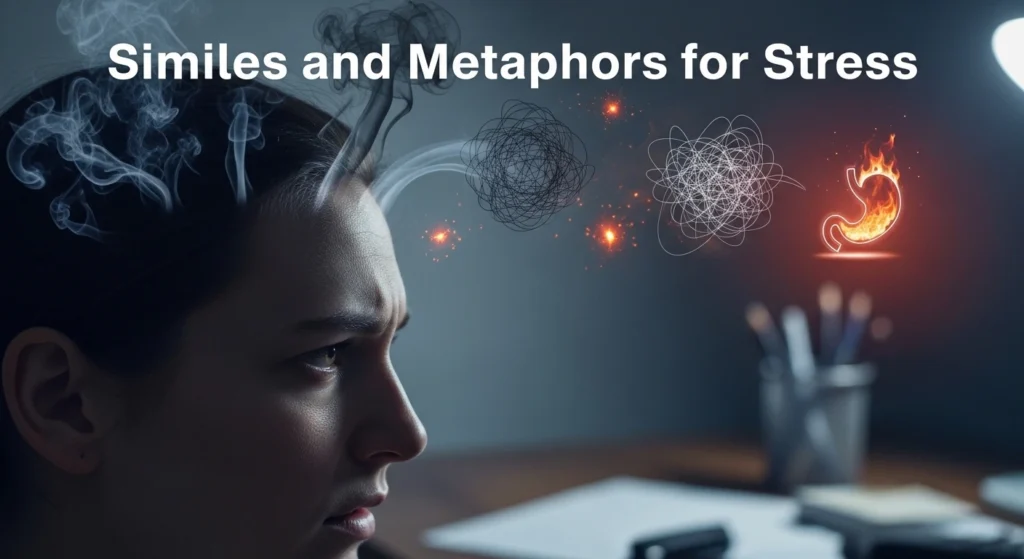
Stress is something everyone experiences, but finding the right words to describe it can be challenging. That’s where similes and metaphors for stress come in. These literary tools allow us to compare our feelings to vivid images, making abstract emotions tangible and relatable.
A simile is a figure of speech that compares two unlike things using words such as like or as. For example, “Stress feels like a storm brewing inside me.” A metaphor, on the other hand, directly states the comparison: “Stress is a storm I cannot escape.” Both help writers, speakers, and even texters communicate complex emotions with clarity and color.
In this guide, we’ll explore 25 unique similes for stress, each explained in detail with tone, context, and real-world examples. Whether you’re writing creatively, journaling, or texting a friend, these comparisons will give your language more depth.
1. Stress is like a ticking time bomb
Definition & Meaning: Stress builds pressure over time, ready to explode if ignored. Tone: Urgent, anxious Best Usage: To convey overwhelming pressure or imminent tension Examples:
- “With deadlines looming, I feel like a ticking time bomb.”
- “Every argument adds another fuse to my ticking time bomb.”
- “She handled the crisis, but inside, she was a ticking time bomb.”
Texting Example: “Ugh, work is piling up—I’m like a ticking time bomb 😩”
2. Stress is like carrying a heavy backpack
Definition & Meaning: Stress can feel like carrying weight on your shoulders. Tone: Burdensome, weary Best Usage: Daily life stress, long-term responsibilities Examples:
- “I’ve been carrying this heavy backpack of stress all week.”
- “Each problem adds another brick to my heavy backpack.”
- “Even simple tasks feel exhausting under my heavy backpack of stress.”
Daily Use Sentence: “Between bills and work, I feel like I’m lugging a heavy backpack everywhere.”
3. Stress is like a stormy sea
Definition & Meaning: Stress can toss you around, unpredictable and turbulent. Tone: Chaotic, overwhelming Best Usage: Emotional instability, conflict Examples:
- “My emotions are a stormy sea after that argument.”
- “She tried to focus, but her mind was a stormy sea of worries.”
- “Stress hit me like waves in a stormy sea.”
Texting Example: “Feeling drowned in a stormy sea of deadlines 😓”
4. Stress is like walking on thin ice
Definition & Meaning: Stress makes situations feel risky or precarious. Tone: Cautious, tense Best Usage: Workplace stress, delicate social situations Examples:
- “Negotiating with him feels like walking on thin ice.”
- “Every mistake makes me feel like I’m on thin ice.”
- “She approached the topic cautiously, walking on thin ice.”
5. Stress is like a knot in your stomach
Definition & Meaning: Stress can create physical discomfort, especially anxiety. Tone: Nervous, uncomfortable Best Usage: Anxiety, anticipation, worry Examples:
- “I had a knot in my stomach before the presentation.”
- “The news left me with a tight knot in my stomach.”
- “Every call from him gave me a knot in my stomach.”
Daily Use Sentence: “I always get a knot in my stomach before exams.”
6. Stress is like a pressure cooker
Definition & Meaning: Stress builds internally until it’s ready to release explosively. Tone: Intense, volatile Best Usage: Work, high-pressure situations Examples:
- “After back-to-back meetings, I feel like a pressure cooker.”
- “He kept quiet, but inside, he was a pressure cooker.”
- “Family drama turned the day into a pressure cooker.”
7. Stress is like juggling flaming torches
Definition & Meaning: Managing stress is risky and requires skill. Tone: Risky, intense Best Usage: Multi-tasking, handling responsibilities Examples:
- “Trying to meet all deadlines is like juggling flaming torches.”
- “She’s juggling flaming torches, but keeps smiling.”
- “Parenting and work sometimes feel like juggling flaming torches.”
8. Stress is like a storm cloud over your head
Definition & Meaning: Stress can feel omnipresent and gloomy. Tone: Moody, oppressive Best Usage: Persistent emotional burden Examples:
- “I walked into the room with a storm cloud over my head.”
- “Her stress followed her like a storm cloud over her head.”
- “Deadlines and bills cast a storm cloud over my week.”
9. Stress is like a tangled ball of yarn
Definition & Meaning: Stress can feel confusing and complex, hard to unravel. Tone: Confusing, frustrating Best Usage: Problem-solving, mental clutter Examples:
- “My thoughts are a tangled ball of yarn today.”
- “Every new worry adds to my tangled ball of yarn.”
- “Sorting out finances feels like untangling a yarn ball.”
10. Stress is like an overflowing kettle
Definition & Meaning: Stress builds until it spills over. Tone: Frustrated, explosive Best Usage: Emotional release, cumulative stress Examples:
- “After a long day, I’m an overflowing kettle.”
- “His patience was an overflowing kettle of frustration.”
- “Family drama makes me an overflowing kettle.”
11. Stress is like running on a treadmill
Definition & Meaning: Constant activity without progress creates stress. Tone: Exhausted, repetitive Best Usage: Workload, feeling stuck Examples:
- “I feel like I’m running on a treadmill at work.”
- “School and chores leave me running on a treadmill.”
- “Endless emails make me run on a treadmill.”
12. Stress is like carrying sandbags
Definition & Meaning: Responsibilities and worries weigh you down. Tone: Heavy, relentless Best Usage: Financial stress, parenting stress Examples:
- “Carrying sandbags of stress every day.”
- “The project added sandbags to her workload.”
- “Debt feels like sandbags tied to my shoulders.”
13. Stress is like a dark tunnel
Definition & Meaning: Stress can feel isolating and uncertain. Tone: Hopeless, tense Best Usage: Anxiety, depression, personal struggle Examples:
- “I feel trapped in a dark tunnel of stress.”
- “Every problem makes the tunnel darker.”
- “She walked through life in a dark tunnel of worry.”
14. Stress is like a swarm of bees
Definition & Meaning: Stress can be overwhelming, buzzing in your mind. Tone: Irritating, chaotic Best Usage: Mental overload, anxiety Examples:
- “My thoughts are a swarm of bees today.”
- “The emails attacked like a swarm of bees.”
- “Stress stings like a swarm of bees.”
15. Stress is like a storm inside your chest
Definition & Meaning: Emotional turbulence affects your body. Tone: Intense, anxious Best Usage: Anger, worry, heartbreak Examples:
- “I felt a storm inside my chest during the argument.”
- “Stress churns like a storm inside my chest.”
- “The news created a storm in her chest.”
16. Stress is like a ticking clock in your head
Definition & Meaning: Constant reminders of pressure heighten anxiety. Tone: Nervous, tense Best Usage: Deadlines, exams, pressure tasks Examples:
- “Deadlines tick like a clock in my head.”
- “Every bill feels like a ticking clock in my head.”
- “Stress ticked like a clock during the presentation.”
17. Stress is like carrying an anchor
Definition & Meaning: Stress can hold you back from moving forward. Tone: Heavy, oppressive Best Usage: Career or personal stagnation Examples:
- “Financial problems are an anchor I carry daily.”
- “Her worries acted like an anchor on her creativity.”
- “The past is an anchor I drag through life.”
18. Stress is like a wildfire
Definition & Meaning: Stress spreads quickly, consuming your focus. Tone: Chaotic, destructive Best Usage: Rapid escalation, overwhelming situations Examples:
- “Rumors spread like wildfire, adding stress.”
- “Anger and stress spread like wildfire in the office.”
- “Her anxiety burned like a wildfire inside her mind.”
19. Stress is like a knot in your brain
Definition & Meaning: Confusion and anxiety tangle your thoughts. Tone: Frustrated, puzzled Best Usage: Mental blocks, overthinking Examples:
- “Exam stress tied a knot in my brain.”
- “Problem-solving created a knot in his brain.”
- “Overthinking tangled a knot in her brain.”
20. Stress is like a shadow that follows you
Definition & Meaning: Stress lingers persistently, everywhere you go. Tone: Persistent, gloomy Best Usage: Chronic stress, low mood Examples:
- “Stress is a shadow that follows me home.”
- “Her worries were a shadow that never left.”
- “Deadlines loom like shadows behind me.”
21. Stress is like a storm in a teacup
Definition & Meaning: Stress may feel overwhelming, but sometimes it’s small in reality. Tone: Exaggerated, anxious Best Usage: Minor worries, blown-out-of-proportion stress Examples:
- “Missing the bus felt like a storm in a teacup.”
- “Overthinking minor mistakes creates a storm in a teacup.”
- “Arguments sometimes seem like a storm in a teacup.”
22. Stress is like a mountain on your back
Definition & Meaning: Stress can feel enormous and immovable. Tone: Overwhelming, heavy Best Usage: Life challenges, long-term responsibilities Examples:
- “Debt feels like a mountain on my back.”
- “She bore a mountain of stress silently.”
- “Parenting alone can feel like carrying a mountain.”
23. Stress is like being trapped in quicksand
Definition & Meaning: The more you struggle, the deeper it pulls you. Tone: Hopeless, anxious Best Usage: Chronic or escalating stress Examples:
- “Work deadlines trap me in quicksand.”
- “I felt like I was sinking in quicksand of stress.”
- “Every new problem pulls me deeper into quicksand.”
24. Stress is like a swarm of ants on your skin
Definition & Meaning: Constant irritations cause a physical sense of unease. Tone: Itchy, restless Best Usage: Minor annoyances, continuous distractions Examples:
- “Emails crawling like ants on my skin.”
- “Her worries crawled like ants under her skin.”
- “Tiny problems feel like ants biting all day.”
25. Stress is like a river in flood
Definition & Meaning: Stress overwhelms, unstoppable and consuming. Tone: Intense, chaotic Best Usage: Emotional breakdown, overload Examples:
- “Anger and worry flowed like a river in flood.”
- “Work stress hit like a river in flood.”
- “Her mind was a river in flood after the argument.”
Conclusion
Using similes and metaphors for stress allows you to give life to abstract emotions, making them relatable and vivid. These comparisons not only enhance creative writing but also help you articulate feelings more clearly in everyday communication. Next time you feel overwhelmed, try describing your stress creatively—it can be therapeutic and insightful.
FAQs
1. What is the difference between a simile and a metaphor? A simile uses “like” or “as” to compare, while a metaphor states the comparison directly.
2. How can I use stress similes in daily life? In texting, journaling, emails, or creative writing to express feelings clearly.
3. Why do similes make writing more engaging? They create vivid imagery, helping readers or listeners feel the emotion.
4. Can similes for stress help with mental health? Yes, expressing stress creatively can provide emotional clarity and relief.
5. Are metaphors better than similes for describing stress? Neither is inherently better—they serve different tones. Metaphors are stronger and more direct; similes are lighter and easier to visualize.

Emily Carter is a grammar coach and freelance writer with a deep love for the English language. She writes engaging lessons and tips on punctuation, spelling, and sentence structure to help learners communicate clearly and effectively.